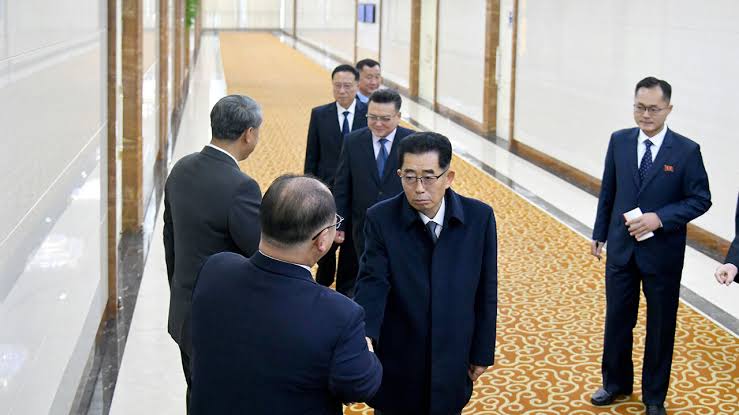
Senior Chinese Communist Party official Cai Qi met a North Korean delegation in Beijing and called for stronger strategic communication and coordination. The visit placed the party-to-party relationship at the centre of bilateral management during a period of weapons tests, sanctions pressure and changing regional diplomacy.
The delegation was led by Kim Song Nam, director of the Workers' Party of Korea's International Affairs Department. His institution manages relations with foreign ruling parties, giving the meeting a political function distinct from formal talks conducted through foreign ministries or military commands.
Cai said China was prepared to implement the consensus reached by the countries' top leaders, preserve their traditional friendship and deepen exchanges on party governance. State reporting also linked closer coordination to peace, stability and development, without identifying a specific initiative or timetable.
The visit followed a major Chinese party conclave focused on tighter internal discipline. North Korean officials can study those methods while Beijing uses governance exchanges to maintain influence through an institutional channel that has survived fluctuations in trade and security policy.
It also came after Kim Jong-un travelled to the Chinese border city of Dandong in late October. High-level contact suggests both governments want to display continuity, even as North Korea expands nuclear and missile capabilities that complicate China's relations with South Korea, Japan and the United States.
No defence pact, sanctions adjustment or economic project was announced. The importance lies in coordination and access: Cai is close to Xi Jinping, while Kim Song Nam connects directly to Pyongyang's party leadership. Such channels can convey priorities when public diplomatic language remains deliberately general.
The relationship should therefore be measured by subsequent action. Trade flows, border management, Chinese enforcement of international sanctions and responses to new North Korean tests will reveal whether the renewed party contact changes policy or mainly protects a longstanding political alliance from regional pressure.