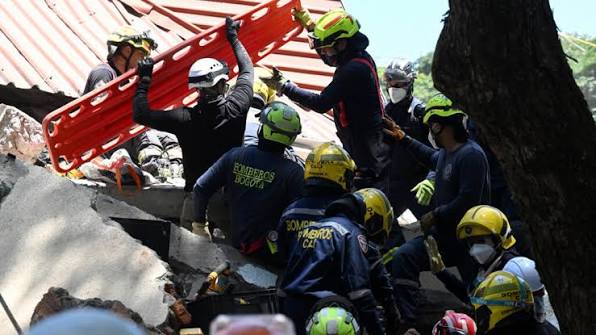
Rescue workers and volunteers searched through collapsed buildings across western Colombia after a magnitude-7.4 earthquake killed at least 111 people. About 1,600 buildings were damaged and at least 61 collapsed in the country's strongest recorded earthquake this century, leaving an unknown number of people trapped beneath debris.
The quake struck near San José del Palmar in the department of Chocó at about 7:30 a.m. local time on Monday. Its focus was roughly 100 kilometres underground, and the initial shock was followed by aftershocks of magnitude 2.8 and 4.8. The movement was felt in Bogotá and across the borders in Ecuador, Venezuela and Panama.
The heaviest losses were reported in the western cities and coffee-growing departments closest to the affected zone. Pereira recorded at least 40 deaths, while Chocó reported 12 dead and 84 injured. President Abelardo de la Espriella later said 35 people had died and 700 had been injured in Valle del Cauca, the department that includes Cali.
In Cali, residents formed human chains to pass chunks of concrete away from collapsed structures while crews stopped periodically to listen for survivors. A six-month-old girl and her mother were pulled from beneath a five-storey building, and rescuers in Pereira established contact with a boy trapped below a bakery as cranes worked above him.
De la Espriella declared a national state of emergency only three days after taking office and made the rescue of people under rubble the government's first priority. Immediate economic resources and humanitarian assistance were allocated for more than 1,400 affected families and individuals, with temporary rent subsidies promised to households whose homes were damaged.
Hospitals in five cities were placed on red alert and at least six airports suspended operations. Authorities imposed nighttime curfews in Cali, Armenia and Manizales, while the government promised 1,000 additional security personnel for Cali after concerns about looting and pressure on public order.
International assistance began to take shape as the United States pledged $15.5 million for emergency shelter, food, protection and damage assessments. Ecuador, France, Mexico and Brazil also offered support, giving the new Colombian administration an early test of its ability to coordinate external help with local rescue operations.
The earthquake's depth would ordinarily have reduced surface shaking, but its magnitude, inland location and strike-slip movement may have amplified damage in populated valleys. Chocó's dense jungle, poverty and reliance on river or air access could slow the wider assessment, making the confirmed national toll provisional while searches continue.