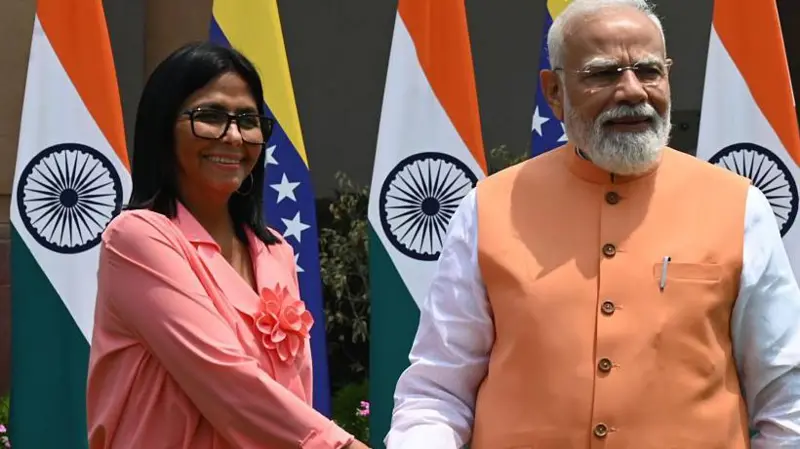
Delcy Rodríguez arrived in India for talks covering trade, investment, health and renewable energy, but the center of gravity in the bilateral relationship remains oil. For New Delhi, the visit comes at a moment when energy security has moved from a commercial calculation to a strategic concern.
India, the world's third-largest oil importer, buys close to 90% of the crude it consumes abroad. Roughly half of those imports, about 2.5 million to 2.7 million barrels a day, normally move through the Strait of Hormuz, a Gulf passage that has been effectively closed by the conflict in Iran. That disruption has made alternative suppliers more valuable.
Venezuela has re-emerged in that context. In May, it became India's fifth-largest crude supplier, delivering around 266,000 barrels a day, or about 5.3% of India's total crude imports. Russia, the United Arab Emirates, Saudi Arabia and Brazil supplied larger volumes, but the Venezuelan flow has become significant because it gives Indian refiners another route away from Middle Eastern dependence.
The rebound follows a year-long interruption linked to U.S. measures against buyers of Venezuelan crude. Indian refiners resumed purchases in February after a sanctions-relief arrangement between Washington and Caracas. Kpler data cited in the report placed Indian imports of Venezuelan crude at around 280,000 barrels a day in April and May, with June arrivals expected to exceed 300,000 barrels a day.
The attraction is not only geopolitical. Venezuelan crude is heavy, sulfur-rich and relatively cheaper to acquire, but it requires sophisticated refining capacity. India has refineries capable of processing that grade efficiently into diesel and jet fuel, making the barrels commercially useful as well as strategically convenient.
The relationship also has limits. Bilateral trade stood at just US$679 million in 2024-25, far below the US$6.4 billion reached in 2019, when oil dominated the exchange and Venezuela shipped about 16 million tons of crude a year to India. Venezuela's output has risen by roughly 400,000 to 500,000 barrels a day this year, but remains well below historical levels.
That means Venezuela is unlikely to transform India's energy matrix by itself. Its larger role, for now, is as a diversification option: a supplier with the world's largest proven oil reserves, existing Indian investment interest, and enough renewed production to matter at a time when New Delhi is trying to reduce exposure to a single supply region.