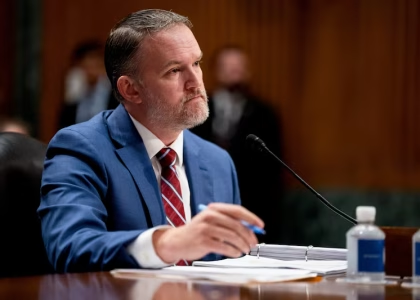
The United States is seeking interim trade arrangements with Mexico and Canada before the end of 2026, even as a full renewal of the U.S.-Mexico-Canada Agreement appears likely to move into next year. U.S. Trade Representative Jamieson Greer outlined that approach during testimony before the Senate Finance Committee, saying Washington wanted at least one arrangement with each partner by year-end.
Greer's remarks indicated that the review of the six-year-old trade pact is unlikely to conclude in 2026. He said issues including rules of origin for autos, labor provisions and environmental regulations would require additional discussion, including with Congress, in the following year.
The delay extends uncertainty for companies and investors across North America. The agreement and its predecessor have structured regional trade for more than three decades, supporting nearly $1.6 trillion in trade that had largely moved across borders without duties.
Tariffs have become a central source of tension in the talks. Mexico and Canada are seeking relief from U.S. national security duties of 25% on autos and 50% on steel and aluminum. Canada has also faced additional pressure after Washington announced a 50% tariff on some Canadian goods, including beer, dairy products and hockey sticks, in response to Ottawa's retaliation against earlier U.S. measures.
The U.S. administration is pushing Mexico to increase regional content requirements for North American-built vehicles in order to qualify for preferential treatment. The stated objective is to encourage more production in the United States and across North America while limiting Chinese-origin content in vehicles.
Mexico broadly shares the goal of strengthening regional production, but differences remain over implementation. Mexican officials have first sought reductions in U.S. tariffs on autos, steel and aluminum, while Greer was due to join bilateral discussions in Mexico City on potential revisions to the trade framework.
Broader political issues may also shape the path to any interim arrangement. Greer told senators that Mexico would need to address concerns beyond trade, including border security and compliance with a 1944 Rio Grande River treaty involving water deliveries to Texas farmers, for President Donald Trump to agree to revisions or renewal.