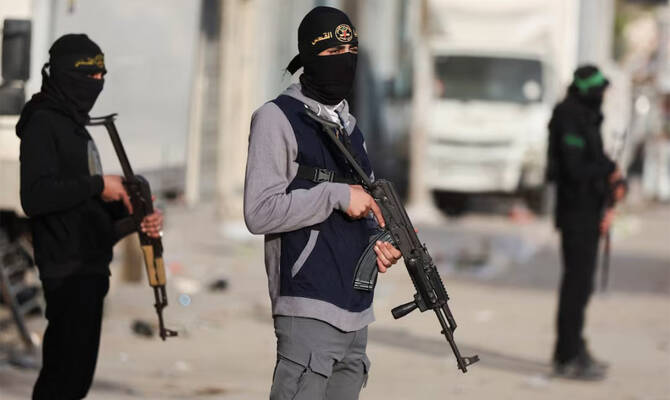
United States President Donald Trump announced that his Board of Peace had reached an agreement for the complete disarmament of Hamas and other armed groups in Gaza. He described the framework as a step toward transferring security and civilian administration to new Palestinian institutions.
The plan calls for weapons to be decommissioned in structured phases. As that process advances, Israeli forces would withdraw and an International Stabilization Force would work with a new Palestinian police service to assume responsibility for security in Gaza.
Implementation is not yet settled. Hamas negotiator Ghazi Hamad said Israel must approve the phased agreement before the movement will carry it out, and that Israel would then have to begin the first phase once both sides accept the text.
The roadmap addresses the main obstacle in the ceasefire's second phase: the future of Hamas's weapons. It also provides for tunnels, arms depots and weapons-production facilities to be eliminated, while heavy and light weapons would come under the control of a transitional Palestinian administration.
That administration, the National Committee for the Administration of Gaza, would be formed by Palestinian technocrats and take over day-to-day governance. A multinational stabilization force operating under the Board of Peace would support the transition and coordinate security arrangements.
Negotiations remain open over the wording. Hamas submitted amendments to two provisions, including alternatives on the weapons clause, while an Israeli political official said the proposal did not yet meet demands for complete disarmament, removal of weapons and full demilitarization of the territory.
Mediators from the United States, Egypt, Qatar and Türkiye are expected to meet in Cairo to discuss the implementation roadmap. The framework includes a verification mechanism intended to monitor compliance by both sides, but no timetable for the meeting or the phases has been finalized.
The diplomatic movement comes while violence continues despite the ceasefire, with four people, including two children, killed in Israeli strikes on Thursday. The agreement therefore remains a negotiated framework rather than an operational settlement until approvals, sequencing and enforcement arrangements are secured.